Revision dates: 5 February 2013, 21 July 2015, 7 February 2017, 13 July 2017
Introduction
In this essay I will estimate the annual contribution to atmospheric green-house gases from methane (CH4) that results from enteric fermentation1 in cattle that graze on U.S. federal public lands. I’ll also compare the CH4 con-tribution of public lands cattle to that of several other sources and sinks of CH4, including emission of CH4 due to oil and gas production on federal lands.
The amount by which the public lands contribution to atmospheric CH4 would change as a result of cattle removal is a more complex matter than are the above-mentioned topics. In the absence of ranching operations, the re-covery of native flora and fauna would provide many new sources and sinks of atmospheric CH4. Although a detailed greenhouse gas analysis of such re-covered ecosystems is beyond the scope of this essay, I will note a few factors that such an analysis should include.
Calculation of Cattle-Emitted CH4 Based on Amount of Forage Consumed
Based on the measurement that a typical grass-fed cow emits 600–700 liters (L) of CH4 per day,2 the mass of this gas annually produced by cattle that graze on 250 million acres of federal public lands managed by the U.S. Forest Service and the Bureau of Land Management (BLM) can be estimated.3 In the interest of producing a conservative estimate, I will perform the calculation using the lower limit (i.e., 600 L) of a cow’s daily CH4 production.
The BLM4 and U.S. Forest Service5 report annual forage utilization from their lands by cattle of 7,920,576 and 6,380,872 animal unit months (AUMs) respectively, with the combined forage utilization being 14,301,448 AUMs.
As each AUM represents 31 days of forage consumption by a cow and her suckling calf, it likewise represents 31 days of the cow’s CH4 production, and therefore each AUM consumed produces 18,600 L of CH4.6
Based on the total number of AUMs used per year and the volume of CH4 emitted per AUM, the annual volume of CH4 produced by public lands cattle is equal to 266,006,932,800 L.7 Since 1,000 L are equivalent in volume to 1 cubic meter (m3), public lands cattle produce 266,006,932 m3 of CH4 per year.
Based on the density of CH4 being 0.68 kg/m3, under assumed conditions of 1.013 bar (one atmosphere) and 15°C (59°F),8 the mass of this volume is 180,884,714.3 kg.9
Gases, such as CH4, contribute to global warming. The relative ability of CH4 to trap heat in the global climate system over a given time frame (com-pared to CO2) is expressed by CH4’s “global warming potential” (GWP).10 Internationally accepted values for CH4’s GWP (with climate-carbon feedback) are “34” over a 100-year interval (GWP100) and “86” over a 20-year interval (GWP20).11 Stated otherwise, over a 20-year interval, a given mass of CH4 would have the same effect in the global climate system as a mass of CO2 that is 86 times greater than that mass of CH4.12
Authors of climate-related articles have often chosen to consider CH4’s impact over a 100-year period. But in 2013, the IPCC noted that “there is no scientific argument for selecting 100 years compared with other choices.”13 Moreover, the IPCC found that at the 20-year timescale, total global emissions of CH4 are equivalent to over 80% of global CO2 emissions.14 In that light, Howarth (2014) argued for focusing on the 20-year rather than the 100-year period based on “the urgent need to reduce methane emissions over the coming 15–35 years.”15
Applying GWP20 for CH4 of 86, the environmental impact of the mass of CH4 produced by public lands cattle is equivalent to 15,556,085,430.14 kg of CO2 (over a 20-year interval).16
Sources of Emissions and Sequestrations of Greenhouse Gases Equivalent to the CH4 Emitted by Cattle on Public Lands
The U.S. Environmental Protection Agency’s online Greenhouse Gas Equivalencies Calculator17 reports that the 15,556,085,430.14 kg of CO2-equivalent annually cow-emitted CH4 is equivalent to any of the following:
• Annual greenhouse gas emissions from 3,288,813 passenger vehicles
• Carbon (C) sequestered by 398,873,984 tree seedlings grown for 10 years
• C annually sequestered by 14,675,552 acres of U.S. forests
• C annually sequestered by 123,992 acres of forest preserved from conversion to cropland.
CO2 emissions from
• 1,750,431,574 gallons of gasoline consumed
• 36,176,942 barrels of oil consumed
• 205,931 tanker trucks’ worth of gasoline
• the electricity use of 2,297,118 homes for one year
• the energy use of 1,642,670 homes for one year
• burning 16,602,012,166 pounds of coal
• burning 82,842 railcars’ worth of coal
• 648,170,225 propane cylinders used for home barbecues
• 4.5 coal-fired power plants for one year.
CH4 Emissions from Cattle Viewed in the Context of CH4 Wasted During Gas and Oil Production
In addition to providing forage for livestock, federal lands produce sig-nificant quantities of oil and natural gas. In FY2014 these lands produced 148,802.95 thousand barrels of oil and 2,499,845.86 million cubic feet of natural gas.18
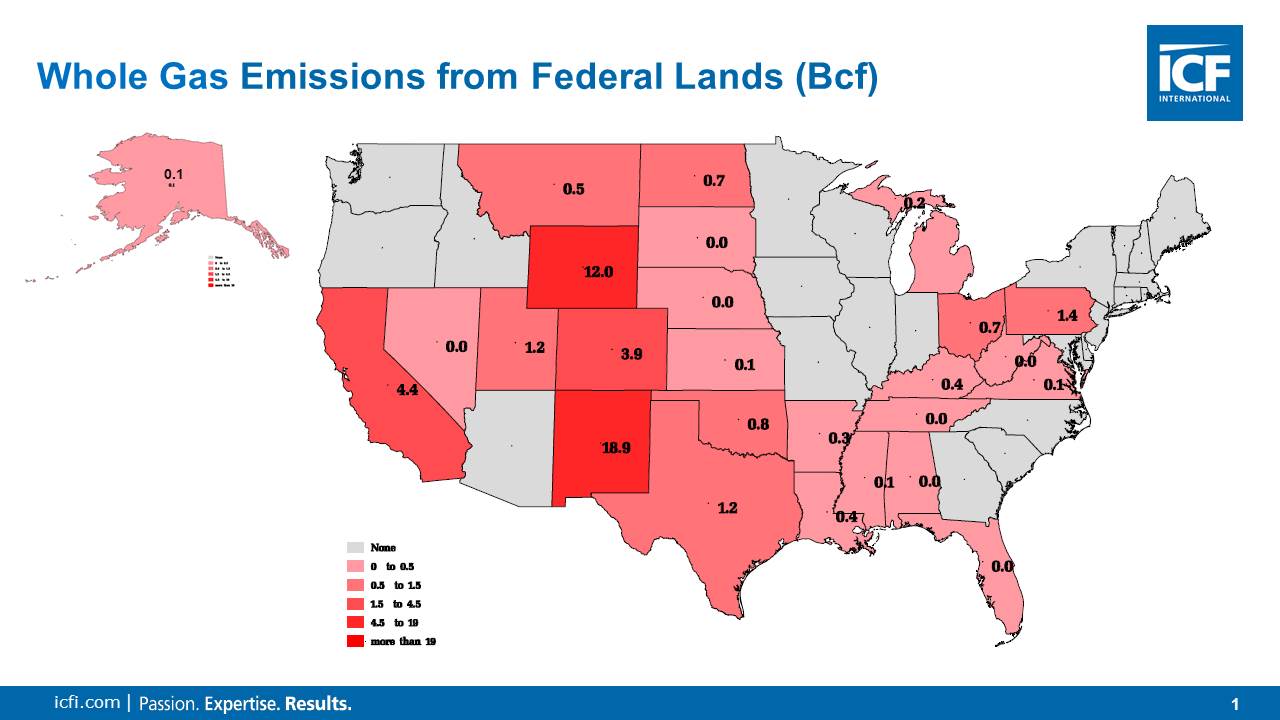
In the course of their installation and operation, these oil and gas wells waste natural gas (primarily consisting of CH4) through venting, flaring, and leaks. An Environmental Defense Fund report dated September 201519 cites an analysis by ICF International20 that estimates these losses for 2013. Based on a graphic produced from the ICF report,21 I compute that these lands accounted for CH4 emissions of approximately 47.2 billion ft3, or equivalently 1,336,555 m3. The 266,006,932 m3 year-1 of CH4 emitted by the cattle on these lands therefore amounts to 19.9% of the CH4 emissions from current oil and gas production.22
On 15 November 2016, the BLM issued a rule that the agency has stated would annually reduce by between 175,000 and 180,000 tons the CH4 that is wasted during the construction and operation of gas and oil wells on public and tribal lands.23 Assuming the less optimistic, lower, value of the range, the CH4 annually emitted by the public lands cattle represents 113.9% of this antici-pated annual reduction.24
Would Removing Cattle from Public Lands Reduce the Lands’ Greenhouse Gas Contribution?
Having determined the quantity of CH4 produced by cattle that graze on public lands, one might ask whether removing these cattle would reduce the greenhouse gas contribution of these public lands by that amount. Although the answer to that question is beyond the scope of this essay, I will indicate a few of the factors that must be considered in seeking the answer.
Removing cattle from public lands would allow several ecosystem com-ponents to begin their recovery from more than a century of harmful impacts. In particular, vegetation that had been consumed by cattle would now be available for wildlife. Consequently, we would expect wildlife populations to increase. And among that wildlife would be native ruminant mammals, such as elk, pronghorn and deer, which, like cattle, emit CH4 as a by-product of their digestion. But such animals produce the gas in much smaller quantities than cattle. For example, an individual deer produces on average only 31.5 grams of CH4 per day25—approximately 7.7% of the amount produced by a cow.26
Perhaps the removal of ranching from federal public lands would reduce much of the public opposition to restoration of predator populations, especially wolves. If predator populations were to increase, they would tend to limit the populations of native ungulate CH4 producers.27
Following the exclusion of cattle, research shows that land-based sources of atmospheric C sequestration may increase. For example, a Chinese temperate grassland after 20 years of grazing exclusion had increased its C storage in the top 40 cm of soil by 35.7%.28 Other research performed on a semiarid, 17-year grazer-excluded grassland in northwest China found similar benefits to sequestration of C and nitrogen (N). The researchers state: “Our results showed that the aboveground biomass, root biomass and plant litter were 70–92%, 56–151% and 59–141% higher, respectively, in grazer excluded grass-land than in grazed grassland. Grazing exclusion significantly increased C and N stored in plant biomass and litter and increased the concentrations and stocks of C and N in soils. Grazing exclusion thus significantly increased the C and N stored in grassland ecosystems. The increase in C and N stored in soil contributed to more than 95% and 97% of the increases in ecosystem C and N storage.”29
Microbiotic crusts,30 which were once prevalent across deserts of the American West, “can be dominant sources of productivity and C sequestration in extremely dry environments.”31 But more than a hundred years of trampling by cattle has markedly reduced the presence of these crusts. And even when cattle impacts are removed, crusts may require from 40 to 250 years to fully recover,32 depending on environmental conditions. Consequently, significant C sequestration by the crusts may not be achieved until many years after the removal of cattle.
Quantifying the biological and chemical processes of these and other greenhouse gas sources and sinks following the cessation of cattle grazing would be a daunting task—one made even more difficult by the need to anticipate impacts on vegetation and wildlife from global climate change.
Acknowledgement
The author thanks T. Shuman for his comments on previous drafts of this essay.
4. Bureau of Land Management, Department of the Interior, “Public Land Statistics 2015,” BLM/OC/ST-16/003+1165, P-108-5, May 2016, p. 87, Table 3-8c (Summary of Authorized Use of Grazing District Lands and Grazing Lease Lands, Fiscal Year 2015), https://www.blm.gov/pub lic_land_statistics/pls15/pls2015.pdf (accessed 16 May 2017).
9. The calculation of 180,884,714.304 kg (CH4 emitted by public lands cattle): 266,006,932.8 m3 (CH4) year-1 × 0.68 kg (CH4) m-3.
10. Description of “global warming potential” excerpted from Wikipedia: “Glo-bal warming potential (GWP) is a relative measure of how much heat a greenhouse gas traps in the atmosphere. It compares the amount of heat trapped by a certain mass of the gas in question to the amount of heat trapped by a similar mass of carbon dioxide. … The GWP depends on the following factors: the absorption of infrared radiation by a given species; the spectral location of its absorbing wavelengths; the atmospheric life-time of the species.” For the full description, see https://en.wikipedia .org/wiki/Global_warming_potential (accessed 9 May 2017).
11. Intergovernmental Panel on Climate Change, Climate Change 2013: The Physical Science Basis, 714, Table 8.7, https://www.ipcc.ch/report /ar5/wg1/ (accessed 13 July 2015).
12. Recent research indicates that CH4’s GWP20 may be as high as 96. See Thomas Gasser, Glen P. Peters, Jan S. Fuglestvedt, William J. Collins, Drew T. Shindell, and Philippe Clais, “Accounting for the Climate-Carbon Feed-back in Emission Metrics,” Earth Syst. Dynam., 8 (2017): 235–53, doi:10.5194/esd-8-235-2017, http://www.earth-syst-dynam.net /8/235/2017 (accessed 7 May 2017).
13. Climate Change 2013, 711.
14. Ibid., 719, Figure 8.32.
15. Robert W. Howarth, “A Bridge to Nowhere: Methane Emissions and the Greenhouse Gas Footprint of Natural Gas,” Energy Science & Engineering, (2014) doi:10.1002/ese3.35, http://onlinelibrary.wiley.com/doi /10.1002/ese3.35/full (accessed 19 July 2015).
16. The calculation of 15,556,085,430.144 kg of CO2-equivalents (over a 20-year interval): [GWP20 (CH4): 86] × 180,884,714.3 kg of CH4.
21. The ICF International graphic titled “Whole Gas Emissions from Federal Lands (Bcf)” reports the following gas (consisting mostly of CH4) emissions (in billion cubic feet) from federal lands which sum to 47.2: AK: 0.1, AL: 0.1, AR: 0.3, CA: 4.4, CO: 3.9, KY: 0.4, LA: 0.4, MT, 0.5, ND: 0.7, NE: 0.1, NM: 18.9, OH: 0.7, OK: 0.8, PA: 1.4, TX: 1.2, UT: 1.2, VA: 0.1, WY: 12.0. http://blogs.edf.org/energyexchange/files/2015 /09/revised-fed-map1.jpg?_ga=2.43200546.663395135.1498 854162-1884747057.1453594421 (accessed 1 July 2017).
22. The calculation of 19.9% of the CH4 emissions from current oil and gas production: 100 × 266,006,932.8 m3 (CH4 from federal public lands cattle) year-1 / 1,336,555,000 m3 (CH4 wasted from federal public lands production of oil and gas) year-1.
24. The calculation of the CH4 emitted by public lands’ cattle as 113.9% of anticipated reduction of CH4 emitted by public lands oil and gas production as a result of the November 2016 BLM regulation: 100 × 180,884,714.3 kg year-1 / (175,000 tons year-1 × 2,000 lb ton-1 × 0.453592 kg lb-1).
26. The estimate from Note 2 of a grass-fed cow emitting 600 L day-1 of CH4 is equivalent (at previously assumed conditions of 1.013 bar and 15°C) to 408 g, of which 31.5 g emitted by a red deer is 7.7%.
27. See, for example, David Christianson and Scott Creel, “Ecosystem Scale Declines in Elk Recruitment and Population Growth with Wolf Colonization: A Before-After-Control-Impact Approach,” PLoS ONE 9(7) (2014): e102330, https://doi.org/10.1371/journal.pone.0102330 (accessed 2 July 2017).
28. Wu L, He N, Wang Y, and Han X, “Storage and Dynamics of Carbon and Nitrogen in Soil after Grazing Exclusion in Leymus Chinensis Grasslands of Northern China,” J. Environ. Qual. 37 (2008): 666, http://www.ncbi .nlm.nih.gov/pubmed/18396553 (accessed 19 July 2015).
29. Qiu L, Wei X, Zhang X, and Cheng J, “Ecosystem Carbon and Nitrogen Accumulation after Grazing Exclusion in Semiarid Grassland,” PLoS ONE 8(1) (2013): e55433.doi:10.1371/journal.pone.0055433, https://doi .org/10.1371/journal.pone.005543 (accessed 2 July 2017).